Our Services
- Home
- Services
ISO 9001:2015 Quality Management Framework
The ISO 9001:2015 standard defines the essential criteria for a quality management system and remains the only certifiable benchmark within its series. Applicable to any organization regardless of size or sector, it currently empowers over one million certified entities across more than 180 countries. This framework is anchored in core principles such as deep customer centricity, proactive leadership commitment, a streamlined process approach, and a culture of ongoing refinement. Implementing ISO 9001:2015 ensures that clients receive consistently superior products and services, fostering significant operational advantages and long-term business growth.
ISO 14001:2015 Environmental Management System
The ISO 14001:2015 standard provides a systematic, process-driven framework for managing business activities that significantly impact the environment. This globally recognized system empowers leadership to maintain a clear oversight of their environmental responsibilities, ensuring strict compliance with evolving legal and regulatory mandates while effectively mitigating associated risks. Designed for universal application, ISO 14001:2015 allows organizations of any size or sector to demonstrate a firm commitment to sustainability on both local and international levels. By integrating this standard, companies can substantially reduce their waste and carbon footprint, ultimately minimizing environmental liabilities and enhancing their reputation in today’s eco-conscious market.
ISO 45001:2018 Occupational Health & Safety Management System
The ISO 45001:2018 standard empowers organizations to adopt a proactive rather than reactive stance toward workplace safety, ensuring the continuous protection of employee health and welfare. This framework utilizes a process-driven approach to systematically monitor and control the diverse risks inherent in daily business operations. By implementing this system, owners and managers gain a deeper understanding of their evolving legal and regulatory accountabilities, allowing them to identify and mitigate hazards with greater precision. Ultimately, achieving ISO 45001 certification serves as a powerful statement to stakeholders, clients, and staff, demonstrating a firm commitment to minimizing operational risks and upholding the highest international standards of occupational safety.
ISO/IEC 27001:2022 Information Security Management System
The ISO/IEC 27001:2022 standard establishes a proactive and systematic framework for managing risks associated with an organization’s confidential data. This system ensures the efficient protection of sensitive information by identifying vulnerabilities and implementing robust defenses against evolving digital and physical threats. By integrating people, processes, and IT systems, the standard treats information as a critical business asset that requires rigorous safeguarding. ISO/IEC 27001 certification is accessible to organizations of all sizes and sectors, enabling them to coordinate security efforts coherently and cost-effectively. Ultimately, adopting this benchmark demonstrates a high level of professional integrity to clients and partners, proving that their personal and corporate data is handled with the utmost security and consistency.
ISO/IEC 20000-1:2018 Information Technology Service Management
The ISO/IEC 20000-1:2018 standard defines the global requirements for a Service Management System (SMS), governing the entire lifecycle of services—from initial design and transition to delivery and continuous refinement. This framework is designed for:
Organizations seeking services from external providers that require verified assurance that their specific requirements will be consistently fulfilled.
Entities that demand a uniform and integrated management approach across all their service providers, including those within complex supply chains.
Service providers aiming to demonstrate a robust capability for the design, transition, and delivery of services that meet rigorous professional standards.
Providers looking to systematically monitor, measure, and review their service management processes to ensure operational efficiency.
Organizations committed to the ongoing improvement of their service delivery through the effective implementation and operation of a high-standard SMS.
Network and Application VAPT
The core objective of a network penetration test is to proactively identify exploitable vulnerabilities across networks, hosts, and infrastructure devices—such as routers and switches—before they can be intercepted by malicious actors. These assessments reveal real-world gaps that could allow unauthorized access to sensitive data or the total compromise of systems for illicit purposes. Our security specialists conduct advanced attack simulations designed to:
Quantify the strategic level of risk for your entire organization.
Evaluate the specific risk exposure within your IT infrastructure.
Pinpoint critical flaws in network security architecture and protocols.
Our expert testers bring deep experience in managing complex systems, not just breaching them, allowing them to focus on high-impact vulnerabilities. Through these tests, you gain a dual perspective: viewing your environment through the eyes of a sophisticated hacker while receiving the technical insight of a seasoned security professional.
Please Note: BSecurity provides independent testing and diagnostic results; we do not offer consulting services or specific remediation implementation based on these findings.
SOC Reports SSAE 18 SOC 1 and SOC 2
A Service Organization Control (SOC) report is the most effective instrument for a service provider to communicate the robustness of its internal controls. These reports are essential for building trust with clients and their auditors regarding financial and operational security.
SOC 1: Internal Control Over Financial Reporting
The SOC 1 report focuses on controls relevant to the user entities’ financial statements. It includes the organization’s system description, a management assertion, and the independent auditor’s opinion. It is divided into two categories:
Type I: Validates the design and implementation of the organization’s system description at a specific point in time.
Type II: Includes the system description and provides rigorous evidence of the controls’ operating effectiveness over a minimum six-month period.
SOC 2 and SOC 3: Trust Services Criteria
These reports are designed to evaluate and communicate information about a system’s performance based on specific Trust Services Criteria:
Security, Availability, and Confidentiality: Ensuring data is protected and accessible only to authorized parties.
Please Note: BSecurity provides independent auditing and reporting services; we do not offer consulting or advisory services for the preparation or remediation of these reports.
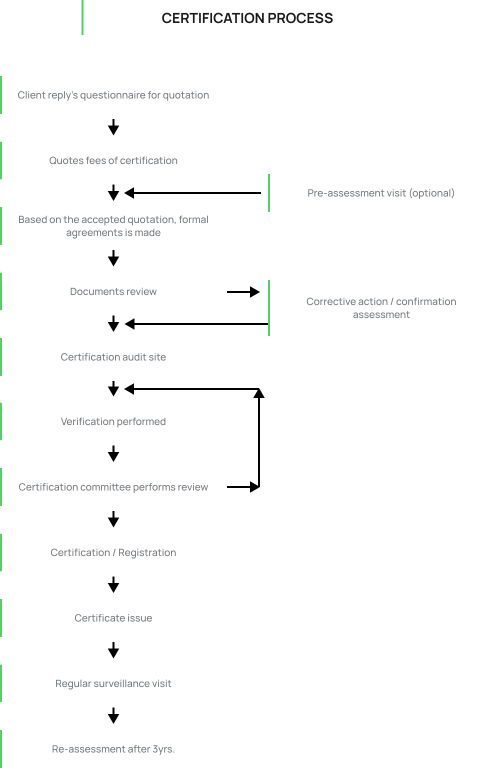
Working Process